



NEWS&EVENTS
Home > News&Events > Company news > Process for producing high-purity antimony by electrolytic refining of antimony ore slurry
As an electrolytic cell manufacturer, we are deeply engaged in the field of antimony ore slurry electrolytic refining, and are committed to achieving efficient preparation of high-purity antimony through diaphragm electrolytic cell technology.
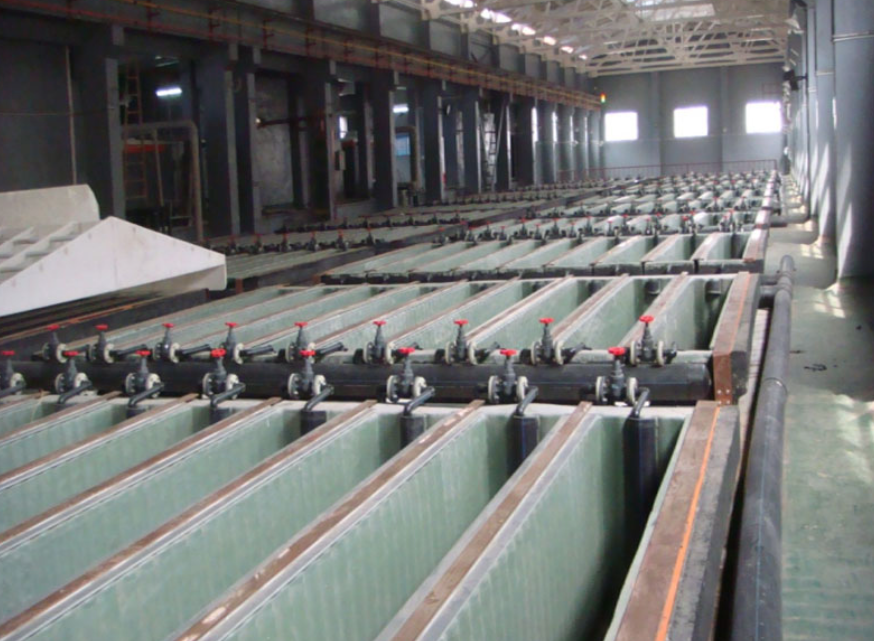
1. Process principle and equipment application
Antimony ore is crushed and ground to form slurry, which is injected into the diaphragm electrolytic cell for electrolysis. The electrolytic cell adopts a bipolar structure design. The anode chamber and the cathode chamber are separated by an ion exchange membrane. The anode material uses a titanium-based coated electrode, and the cathode uses a copper sheet or a stainless steel plate. During the electrolysis process, antimony ions are reduced to metallic antimony at the cathode, and an oxidation reaction occurs at the anode. Impurity elements enter the anode mud or electrolyte to achieve the separation of antimony and impurities.
2. Technical advantages
Compared with traditional pyrometallurgy, slurry electrolytic refining has significant advantages: first, energy consumption is reduced by more than 30%, and the electrolysis process is carried out at room temperature, avoiding high-temperature volatilization losses; second, the antimony recovery rate is increased to more than 95%, and impurity elements are effectively blocked by ion exchange membranes, and the product purity is more than 99.99%; third, the electrolyte can be recycled, and the amount of waste liquid treatment is reduced, which is in line with the development trend of green metallurgy.
3. Process settings
The electrolyte adopts a mixed system of hydrogen fluoride, antimony fluoride and sulfuric acid. The sulfuric acid concentration is controlled at 100g/L, the free hydrogen fluoride is 20g/L, the current density is set to 100A/m2, and the cell voltage is 0.5V. The electrolysis cycle is 5-7 days, and the anode residual rate is controlled at 15%-20%. The diaphragm electrolytic cell is equipped with an intelligent circulation system to monitor the electrolyte composition and temperature in real time to ensure the stability of the electrolysis process.
The process waste liquid can be recycled after treatment. In the future, we will continue to optimize the structure and electrolysis parameters of antimony electrolytic cells to promote the development of the antimony smelting industry in a more efficient and environmentally friendly direction.