



NEWS&EVENTS
Home > News&Events > Company news > Rotary refining furnace: slag formation and antimony metal purification
In the metallurgical industry of antimony, refining furnaces are key equipment for purifying crude antimony. Its core task is to remove harmful impurities such as iron, arsenic, lead, etc. from crude antimony through physical and chemical means, in order to obtain high-purity antimony solution. This process is not only related to product quality, but also closely related to resource utilization and environmental protection, and the core mechanism is "slag making".
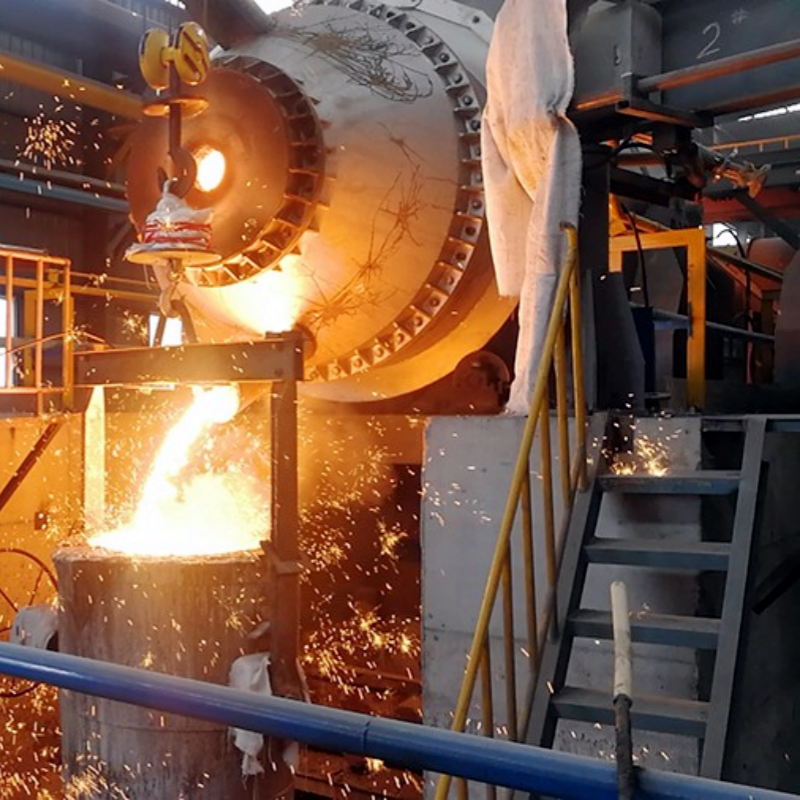
A refining furnace is a container for high-temperature reactions. After the crude antimony melts in the furnace, a specific refining agent is added, and a sophisticated process aimed at separating impurities begins immediately. Slag making is the soul of this process. The main function of refining agents is to undergo directional chemical reactions with impurities, generating a substance in a molten state that has different properties from antimony liquid - slag. For example, to remove iron, refining agents can oxidize and convert it into compounds such as iron silicate; For arsenic, lead, etc., corresponding salts or oxides are formed. These newly generated compounds, together with the refining agent itself, form a low-density and well flowing molten slag phase, known as "antimony slag". Due to incompatibility with antimony liquid and density difference, the slag phase naturally floats up and covers the surface of antimony liquid, thereby achieving efficient separation of impurities from the main metal. Regularly removing this layer of antimony slag rich in impurities is the key operation to obtain pure antimony solution.
Therefore, in addition to obtaining pure antimony liquid as the main product in the refining furnace, there will inevitably be by-products that need to be properly treated. The most important of these is antimony slag, which is a complex solid waste that requires environmental disposal or valuable element recovery. In addition, the refining process may be accompanied by the generation of a small amount of flue gas, mainly from the escape of certain volatile impurities, which requires a complete flue gas purification system to ensure environmental safety.
In summary, the essence of a refining furnace lies in achieving precise "slagging" through refining agents. This process not only efficiently purifies antimony metal, but also solidifies impurities in the form of slag phase, reflecting the wisdom of "separation and purification" in metallurgical processes. A deep understanding and optimization of the slag making mechanism is an important cornerstone for improving the efficiency of antimony smelting and achieving green production.