



NEWS&EVENTS
Home > News&Events > Company news > Extraction of gold and silver from anode mud in antimony electrolytic refining
Anode mud produced during antimony electrolytic refining is rich in precious metals such as gold and silver, requiring efficient recovery through a systematic process. The main steps include pretreatment, chloride leaching, extraction and purification, and electrolytic refining.
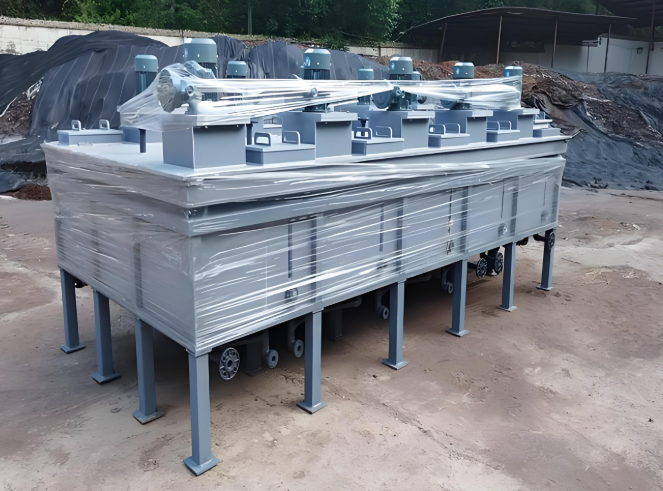
First, the anode mud undergoes pre-treatment in a pulping machine before entering a vacuum filtration system for solid-liquid separation. The filter residue undergoes multiple washings to ensure maximum solubility of the gold and silver in the liquid phase. The slurry is then transferred to a chlorination kettle for chlorination leaching, converting the gold and silver into soluble chlorides.
After purification, the chlorinated solution enters a four-stage countercurrent extraction system, where a specific organic phase is used to selectively extract gold. The raffinate is returned to the front end of the process for reuse, while the gold-rich organic phase undergoes a secondary wash for further purification. The washed organic phase then enters an electrolytic cell, where direct current is applied to deposit gold at the cathode.
Finally, the gold deposits obtained through electrolysis are melted and formed in a vacuum casting machine under a protective atmosphere, resulting in gold ingots with a purity of 99.9%. The entire process is sealed by a vacuum system, which not only improves metal recovery rates but also effectively reduces environmental pollution, achieving efficient and green recovery of gold and silver resources.
This process successfully achieves the efficient extraction of high-purity gold and silver products from antimony anode mud by integrating key technologies such as vacuum filtration, chlorination leaching, solvent extraction and electrolytic refining.