



NEWS&EVENTS
Home > News&Events > Company news > Main technical points for maintenance of antimony electrolytic cell after shutdown
As the core equipment for antimony metal production, the stable operation of the electrolytic cell directly affects product quality and production safety. Scientific maintenance during downtime is a key link to extend the service life of the equipment and ensure the continuity of subsequent production. The following are the technical points of antimony electrolytic cell downtime maintenance from multiple aspects:
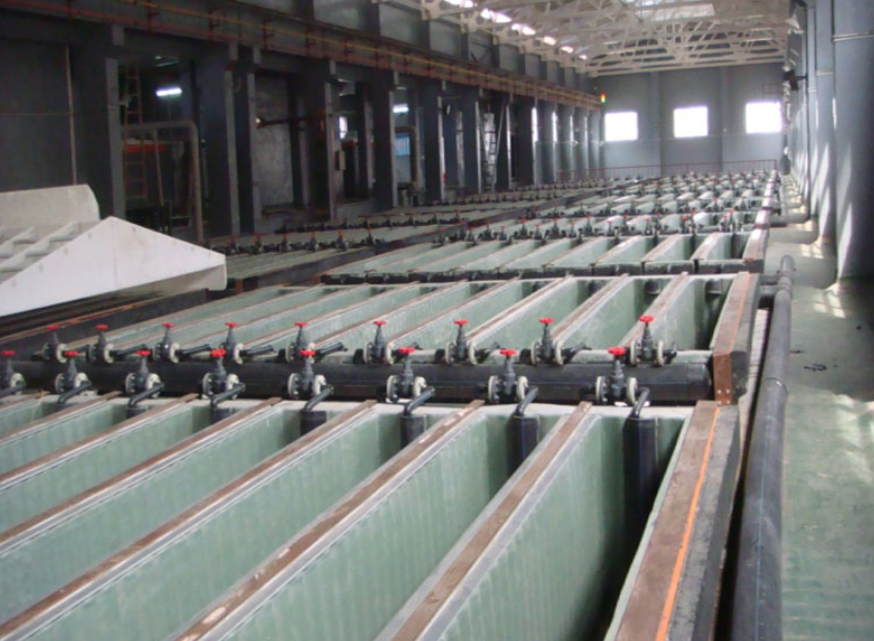
1. Electrolyte discharge and tank cleaning
After shutdown, the electrolyte discharge procedure should be started immediately, and all the electrolyte should be transferred to the storage tank through a dedicated pipeline. However, attention should be paid to the discharge speed to prevent the tank from deforming due to sudden temperature changes. After being completely emptied, use 30-40℃ soft water for three cycles of flushing. For the first flush, add 0.5% citric acid solution to remove sulfide deposits on the electrode surface.
2. Maintenance of the electrode system
Use a digital potentiometer to test the electrochemical performance of the anode plate. When the measured antimony electrode potential deviation exceeds ±0.05V, the anode needs to be activated. The activation process uses 5% sulfuric acid solution at 60℃ for 4 hours, and then deionizes and rinses. The cathode copper bar needs to check the flatness of the conductive contact surface. When the contact resistance exceeds 0.5mΩ, it needs to be ground with 200-grit sandpaper. For electrode groups that have been used for more than 8,000 hours, preventive replacement is recommended.
III. Sealing system maintenance
Check the compression deformation of the slot cover sealing gasket. Replace it if it exceeds 15%; use a laser level to measure the flatness of the sealing surface with an error of ±0.1mm. Use an infrared thermal imager to measure the anti-corrosion layer of the FRP slot cover. If it is peeled off more than 5cm2, use epoxy vinyl ester resin to repair it. Apply conductive anti-corrosion paste to the connection of the metal slot body, and the ground resistance is ≤0.1Ω.
IV. Auxiliary system maintenance
Check the mechanical seal leakage of the circulation pump. If it is greater than 3ml/h, replace the sealing component; perform a 0.6MPa water pressure test on the cooling water pipeline, and maintain the pressure for 30 minutes without leakage to be qualified. The electrical control system measures the insulation resistance of the rectifier cabinet, and the insulation of the main circuit to the ground is greater than 10MΩ; the temperature sensor is calibrated at three points with a standard source, and the error is ≤±1℃.
5. Anti-corrosion protection treatment
The inner wall of the tank body is sprayed with graphite-based anti-corrosion paint with a dry film thickness of 80-100μm; the exposed metal parts are coated with a protective layer of silane coupling agent, focusing on protecting the easily corroded parts. For equipment that has been shut down for more than 72 hours, a desiccant bag is placed in the tank body, and the humidity is ≤40%RH to prevent moisture.
By systematically executing the above maintenance process, the technical performance of the electrolytic cell can be effectively restored, and the equipment failure rate can be reduced by more than 65%. It is recommended to establish an equipment health file to record the key parameters of each maintenance to provide data support for the formulation of preventive maintenance strategies. As an electrolytic cell manufacturer, we recommend that users conduct a comprehensive overhaul after each production cycle to ensure that the equipment is always in the best working condition.