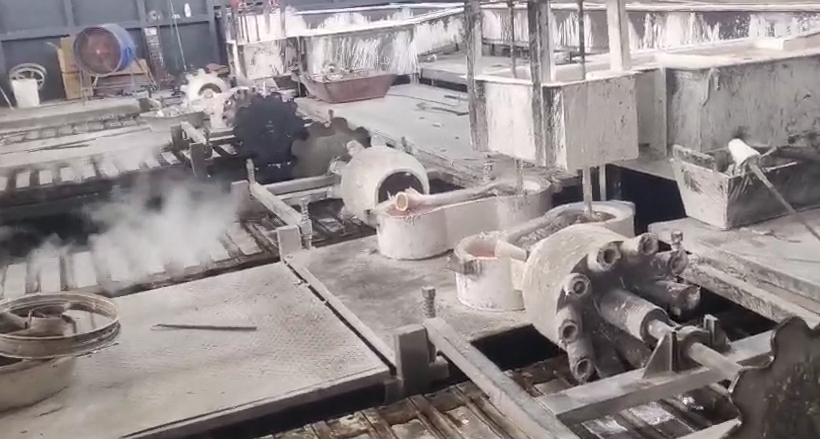
Pure aluminum and recycled aluminum are used, and other elements such as silicon (Si), copper (Cu), magnesium (Mg), iron (Fe) are added according to international standards or special needs. The ingot casting process is completed with the cooperation of the melting furnace and the ingot casting machine.
1. Raw material preparation
During the melting and casting process of aluminum alloy ingots, the required raw materials must be pre-treated first. The raw materials are generally aluminum alloy blanks with alloy additives. The aluminum alloy blanks are obtained by smelting aluminum ore and other metal elements. The composition and properties of the aluminum alloy are regulated by alloy additives.
2. Melting aluminum alloy
In the melting furnace, the pre-prepared blanks are melted together with the alloy additives. The metal smelting furnace generally uses an electric furnace or a gas furnace to melt the aluminum alloy blanks and alloy additives at high temperature to make them liquid. During the smelting process, the melting temperature and time must be strictly controlled to ensure the chemical composition and purity of the aluminum alloy.
3. Purification treatment
After the smelting is completed, there may be some impurities and gases in the aluminum alloy, which need to be purified. Common purification methods include degassing and impurity removal. Degassing is to add an appropriate amount of hydrogen or nitrogen to dissolve and release the gas at high temperature, thereby reducing the gas content in the aluminum alloy. De-impurity is to add an appropriate amount of purifier to react the impurities in the aluminum alloy with the purifier to form an easily separable substance, thereby reducing the impurity content in the aluminum alloy.
After the smelting is completed, the aluminum alloy must be purified because it contains a large amount of impurities and gases. Common purification methods include degassing and de-impurity. Degassing refers to adding a certain proportion of hydrogen and nitrogen to the aluminum alloy to dissolve and release the gas at a higher temperature to achieve the purpose of reducing the gas content of the aluminum alloy. De-impurity is to add a certain amount of purifier to the aluminum alloy to react chemically with the impurities in the alloy to generate easily separable substances and reduce the impurity content in the alloy.
IV. Casting and molding
After the purification treatment is completed, the aluminum alloy is poured into a pre-prepared mold for casting and molding. The mold can be designed and manufactured according to the required shape and size. During the casting process, the casting speed and temperature need to be controlled to ensure that the aluminum alloy fully fills the mold and obtains a uniform solidification structure.
After purification, it is poured into the prepared mold for pouring. The mold can be designed and made according to the shape and size required by the customer. In order to ensure that the aluminum alloy fully fills the mold, the pouring rate and temperature must be controlled.
5. Cooling and solidification
After the pouring is completed, the aluminum alloy is placed in the mold for cooling and solidification. During the use of aluminum alloy, it should be reasonably cooled naturally or water-cooled according to its composition, thickness and other factors. In general, the cooling and solidification time are relatively long, and it is necessary to wait until the aluminum alloy is completely solidified before continuing.
6. Removing the mold
After cooling and solidification, remove the aluminum alloy ingot from the mold. Pay special attention during the material removal process to avoid damage to the shape and surface quality of the aluminum ingot.
7. Processing
After taking out the ingot, in order to meet special requirements, it needs to be further processed. Mechanical processing may include forging, rolling, stretching, milling, etc., in order to obtain the required shape, size and surface quality.
8. Quality inspection and packaging
After the processing is completed, the aluminum alloy ingot is inspected for quality. Common quality inspection items include appearance inspection, size inspection, chemical composition analysis, etc. After passing the quality inspection, it is packed according to regulations for easy storage and transportation.
The above is all the processes, among which the ingot casting machine plays a huge role.