



NEWS&EVENTS
Aluminum ash is a solid waste generated during the aluminum industry's production process, and its recycling and treatment are of great significance for resource recycling and environmental protection. The rotary furnace process for aluminum ash is an effective method for processing it, and the specific process is as follows: Pretreatment is the first step. The aluminum ash needs to be crushed and screened to remove large impurities and control the appropriate particle size to improve the efficiency of subsequent reactions. Afterwards, it is mixed with fluxes such as fluoride and chloride salts to lower the melting point of the aluminum ash. Reducing agents such as coke can also be added to assist the reduction reaction.
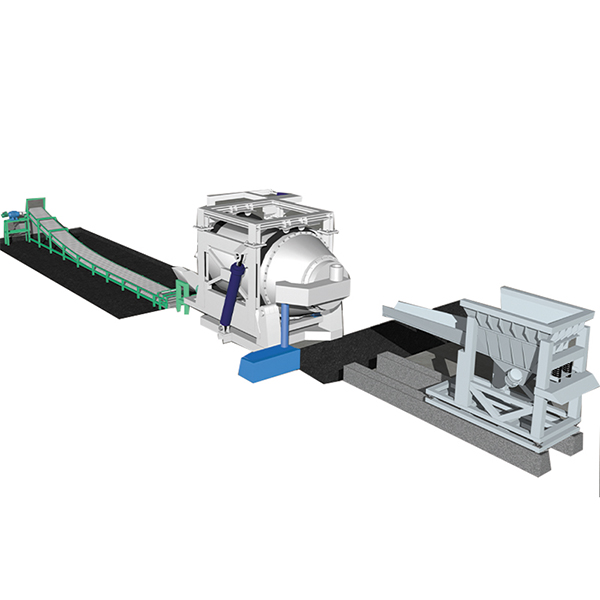
Next is the feeding and heating stage. The pretreated aluminum ash is conveyed by a screw conveyor or directly poured into the rotary furnace. The rotation of the furnace ensures uniform material distribution. The temperature is then raised to the target temperature, generally 750–850°C, at which temperature the aluminum gradually melts, and the reaction continues for several hours.
The smelting and separation stage begins. The rotary furnace continues to rotate and stir, promoting the polymerization of the molten aluminum and effectively separating it from the slag phase. The aluminum is then discharged in layers. Molten aluminum is discharged from the bottom outlet and recycled after casting into ingots; the residue, containing oxides, salts, and other substances, is discharged from the slag outlet.
Waste gas treatment is also crucial. The high-temperature flue gas first undergoes rapid cooling and baghouse dust collection to remove particulate matter, then passes through an alkaline scrubbing tower to absorb acidic gases such as HCl and HF. To control dioxin formation, the combustion temperature must be ensured to be above 850°C, or activated carbon adsorption must be used.
Finally, the residue is utilized. The detoxified residue can be used to produce building materials, such as as a cement raw material, or it can be landfilled, achieving resource utilization. Through the aluminum ash rotary furnace process, aluminum ash is efficiently recycled, reducing environmental pollution and achieving resource recycling.